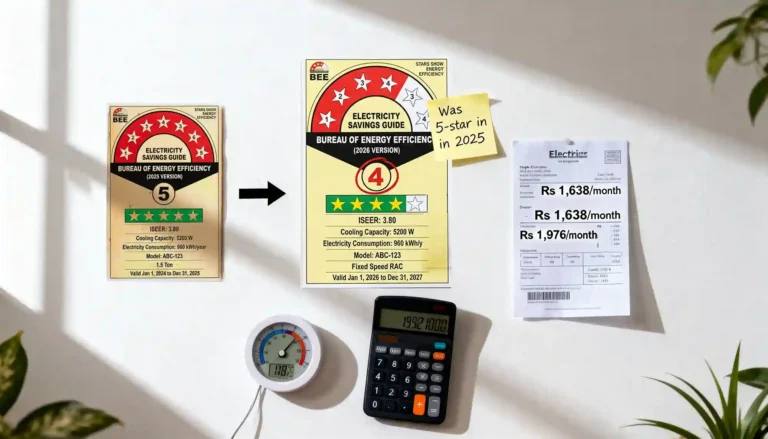
Many buyers have been confused by AC star ratings changing. A shortlisted model can be rated 4-star under the new table even when its ISEER value is the same as an AC that was rated 5-star before. Same efficiency, different star count.
He was not getting cheated. What happened to him is the BEE star rating changed 2026, explained simply: on January 1, 2026, the Bureau of Energy Efficiency raised the ISEER thresholds for every star level. A 5-star AC from 2025 is now 4-star. Not because it got worse. Because the bar moved. This is the BEE star rating 2026 new rules situation that confused buyers across India in the first half of this year, and this guide explains it completely with real electricity bill calculations for your city.
The most common questions we get: how much electricity does 5 star AC use per hour, what is the 3 star vs 5 star AC electricity difference in rupees, and is a 1 ton 5 star AC electricity bill per month actually lower than a 3-star? All three are answered below with verified data from BEE and state electricity regulators.
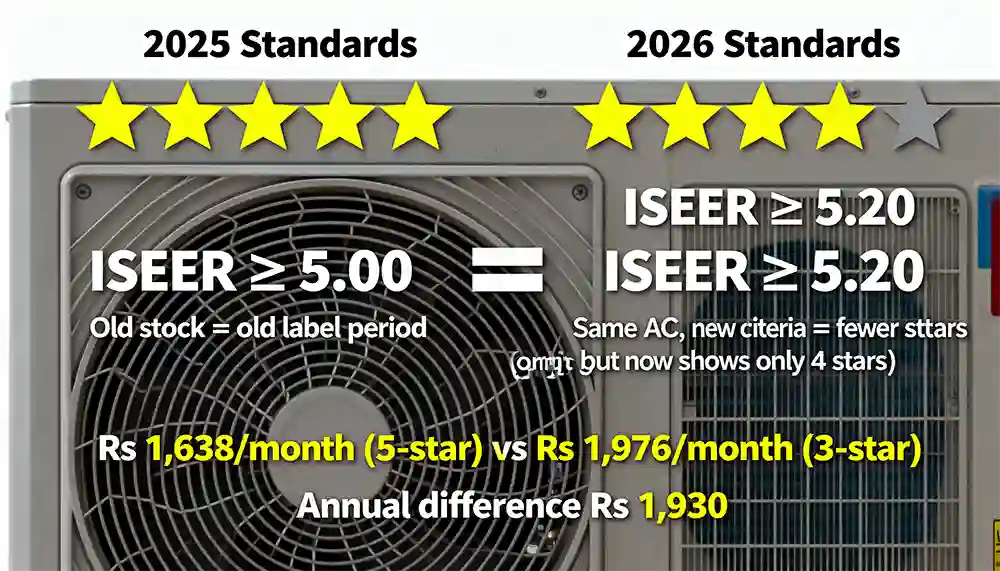
Five stars in 2025.
Four stars in 2026.
The AC did not change.
BEE raised the bar.
Full breakdown at BestBudgetPicks.in
Table of Contents
- BEE Star Rating Changed 2026 Explained
- ISEER: The Number Behind the Stars
- 2025 vs 2026 BEE Star Rating Table
- How Much Electricity Does 5 Star AC Use Per Hour
- 1 Ton 5 Star AC Electricity Bill Per Month
- 3 Star vs 5 Star AC: Full Electricity Difference
- Star Rating AC Electricity Bill Calculator by City
- Is 5-Star AC Worth the Extra Cost
- How to Read a BEE Label in 2026
- Frequently Asked Questions
BEE Star Rating Changed 2026 Explained: Why Your 5-Star AC Is Now 4-Star
The BEE star rating changed 2026 due to what the Bureau of Energy Efficiency calls the Efficiency Ratchet. Every 3 to 4 years, BEE raises the minimum ISEER required to earn each star level. This is deliberate government policy to force manufacturers to build increasingly efficient appliances over time.
The BEE star rating 2026 new rules came into effect on January 1, 2026. Under these new rules, the minimum ISEER for a 5-star AC increased from 5.00 to 5.20. An AC that was legitimately 5-star in 2025 with ISEER 5.05 is now rated 4-star under the BEE star rating 2026 new rules. The appliance has not changed. The label criteria has moved.
This change applies to split inverter ACs, window ACs, and several other large appliances including refrigerators. For buyers in India, the practical implication is simple: any BEE label on an appliance that shows a validity period of 2022-2025 is using the old rating criteria. You need a label that says “1 January 2026 to 31 December 2028” to be comparing under the same current BEE star rating 2026 new rules.
ISEER Explained: The Number That Determines Your Electricity Bill
BEE star ratings are based on ISEER, the Indian Seasonal Energy Efficiency Ratio. ISEER = Total cooling provided (kWh) divided by Total electricity consumed (kWh). An AC with ISEER 5.2 delivers 5.2 units of cooling for every 1 unit of electricity consumed. Higher ISEER means lower electricity bill.
India needed its own metric because the older EER was measured at 35 degrees Celsius at full load only. That number does not reflect real bills in Chennai at 40 degrees, Delhi at 47 degrees in May, or Bengaluru at 28 degrees year-round. ISEER tests across a range of temperatures that represent actual Indian seasonal use, making it a far more accurate predictor of the 3 star vs 5 star AC electricity difference you will see on your real monthly bill.
One point most buyers miss: within a single star band, ISEER values vary significantly. Two different 3 star ACs can have ISEER 4.3 and ISEER 4.6. Both are 3-star. The one with ISEER 4.6 uses approximately 7 percent less electricity every year. Always read the ISEER number on the BEE label, not just the stars.
2025 vs 2026 BEE Star Rating: Complete ISEER Comparison Table
| Star Rating | Old ISEER (2022-2025) | New ISEER (2026-2028) | Effect on Existing ACs |
|---|---|---|---|
| 5 Star | ISEER ≥ 5.00 | ISEER ≥ 5.20 | ISEER 5.00-5.19 now 4-star |
| 4 Star | ISEER 4.50-4.99 | ISEER 4.75-5.19 | Many 2024 4-star now 3-star |
| 3 Star | ISEER 3.99-4.49 | ISEER 4.25-4.74 | Some 2024 3-star now 2-star |
| 2 Star | ISEER 3.49-3.98 | ISEER 3.75-4.24 | Thresholds raised across board |
| 1 Star | ISEER 2.90-3.48 | ISEER 3.25-3.74 | Lowest tier raised too |
Practical example: A 5 star AC with ISEER 5.05 was legitimate 5-star in 2025. Under BEE star rating 2026 new rules, the same AC is 4-star because the 5-star minimum moved to 5.20. The 3 star vs 5 star AC electricity difference under the new 2026 rules is even larger than before because both thresholds shifted upward, making today’s 3-star ACs genuinely more efficient than 2022-era 3-star models.
How Much Electricity Does 5 Star AC Use Per Hour in India 2026
The question “how much electricity does 5 star AC use per hour” is the most searched AC-related query in India, and the answer depends on the tonnage. Here are the exact numbers for 1-ton and 1.5-ton ACs under the 2026 BEE star rating standards:
For a 1-ton 5 star AC under 2026 BEE norms: approximately 650 to 720 watts per hour at average Indian conditions. This translates to 0.65 to 0.72 units of electricity consumed per hour of operation.
For a 1.5-ton 5 star AC under 2026 BEE norms: approximately 950 to 1,000 watts per hour at average Indian conditions. This translates to 0.95 to 1.0 units of electricity consumed per hour.
For comparison, how much electricity does 5 star AC use per hour versus a 3 star AC of the same tonnage: a 1.5-ton 3 star AC uses approximately 1,150 to 1,200 watts per hour. The 3 star vs 5 star AC electricity difference per hour is approximately 200 to 250 watts, which compounds significantly over a season.
| Star Rating (2026) | 1-Ton Watts/Hour | 1.5-Ton Watts/Hour | Units per Hour (1.5T) |
|---|---|---|---|
| 5 Star | 650-720W | 950-1,000W | 0.95-1.0 units |
| 4 Star | 720-820W | 1,050-1,100W | 1.05-1.10 units |
| 3 Star | 820-930W | 1,150-1,200W | 1.15-1.20 units |
| 2 Star | 930-1,050W | 1,300-1,350W | 1.30-1.35 units |
| 1 Star | 1,100-1,200W | 1,500-1,550W | 1.50-1.55 units |
1 Ton 5 Star AC Electricity Bill Per Month in India 2026
The 1 ton 5 star AC electricity bill per month is the most practically relevant calculation for Indian buyers with smaller rooms. A 1-ton AC is the right size for rooms between 80 and 120 square feet, which covers most Indian urban bedrooms.
For a 1 ton 5 star AC running 8 hours per day for 30 days under 2026 BEE standards:
| Electricity Rate | 1-Ton 5-Star Monthly Units | 1-Ton 5-Star Monthly Bill | 1-Ton 3-Star Monthly Bill | Monthly Saving |
|---|---|---|---|---|
| Rs 5/unit (low cost states) | ~168 units | Rs 840 | Rs 1,056 | Rs 216 |
| Rs 6.50/unit (Delhi) | ~168 units | Rs 1,092 | Rs 1,373 | Rs 281 |
| Rs 7/unit (national avg) | ~168 units | Rs 1,176 | Rs 1,478 | Rs 302 |
| Rs 9/unit (Mumbai high slab) | ~168 units | Rs 1,512 | Rs 1,901 | Rs 389 |
The 1 ton 5 star AC electricity bill per month ranges from Rs 840 in low-cost electricity states to Rs 1,512 in Mumbai’s upper consumption slab. This compares to Rs 1,056 to Rs 1,901 for a 1-ton 3-star AC running the same hours. The 1 ton 5 star AC electricity bill per month is consistently 20 to 25 percent lower than the equivalent 3-star bill, which translates to Rs 216 to Rs 389 in monthly savings depending on your city.
3 Star vs 5 Star AC: Full Electricity Difference in India 2026
The 3 star vs 5 star AC electricity difference under the 2026 BEE star rating standards is the core buying decision for most Indian households. Here is the complete honest comparison for 1.5-ton ACs running 8 hours per day for 30 days:
| Metric | 5-Star AC (2026) | 3-Star AC (2026) | 3 Star vs 5 Star AC Difference |
|---|---|---|---|
| ISEER | ≥ 5.20 | 4.25-4.74 | 18-22% more efficient |
| Watts per hour | ~975W | ~1,175W | ~200W more per hour |
| Units per month (8hr/day) | ~234 units | ~282 units | ~48 units difference |
| Monthly cost (Rs 7/unit) | Rs 1,638 | Rs 1,974 | Rs 336 per month saved |
| Monthly cost (Rs 9/unit) | Rs 2,106 | Rs 2,538 | Rs 432 per month saved |
| Annual season saving | 5 months | baseline | Rs 1,680-2,160/year |
| 10-year total saving | lifetime | baseline | Rs 16,800-21,600 |
The 3 star vs 5 star AC electricity difference of 48 units per month sounds modest until you account for two India-specific factors. First, Mumbai’s tiered tariff means those 48 units are charged at Rs 12.04 per unit if your total consumption is above 500 units. At that rate, the 3 star vs 5 star AC electricity difference in Mumbai is Rs 578 per month. Second, an inverter AC runs more efficiently when it is not working at full capacity. A 5 star inverter AC at 60 percent load in Bengaluru’s mild climate will use even less than the label estimate, widening the 3 star vs 5 star AC electricity difference further from the published numbers.
Star Rating AC Electricity Bill Calculator: Real Numbers by Indian City
Use this star rating AC electricity bill calculator table for the most common Indian cities. These are real calculations using 2026 SERC-approved tariff rates, not estimates. The star rating AC electricity bill calculator uses actual state tariff orders verified against official electricity regulator websites.
Assumptions for this star rating AC electricity bill calculator: 1.5-ton split inverter AC, 8 hours per day, 30 days, household consumption falls in the middle-to-high consumption slab per state tariff structure.
| City | Rate/Unit | 5-Star Monthly Bill | 3-Star Monthly Bill | Monthly Saving | Annual Saving |
|---|---|---|---|---|---|
| Mumbai (MSEDCL) | Rs 8.88-12.04 | Rs 2,078-2,818 | Rs 2,504-3,394 | Rs 426-576 | Rs 2,130-2,880 |
| Delhi (BSES) | Rs 6.50 | Rs 1,521 | Rs 1,833 | Rs 312 | Rs 1,560 |
| Bengaluru (BESCOM) | Rs 5.80 | Rs 1,357 | Rs 1,636 | Rs 279 | Rs 1,395 |
| Chennai (TANGEDCO) | Rs 5.50 | Rs 1,287 | Rs 1,551 | Rs 264 | Rs 1,320 |
| Hyderabad (TSSPDCL) | Rs 6.00 | Rs 1,404 | Rs 1,692 | Rs 288 | Rs 1,440 |
| Pune (MSEDCL) | Rs 5.71-8.88 | Rs 1,336-2,078 | Rs 1,610-2,504 | Rs 274-426 | Rs 1,370-2,130 |
| Kolkata (CESC) | Rs 7.50 | Rs 1,755 | Rs 2,115 | Rs 360 | Rs 1,800 |
| Ahmedabad (UGVCL) | Rs 5.50 | Rs 1,287 | Rs 1,551 | Rs 264 | Rs 1,320 |
How to use this as your personal star rating AC electricity bill calculator: find your city rate in the table, multiply the units column by your actual rate. If you run the AC 6 hours instead of 8, multiply the bill by 0.75. If you run it 10 hours, multiply by 1.25. This star rating AC electricity bill calculator gives you a starting point; your actual bill depends on your specific usage pattern and which tariff slab your total household consumption falls in.
Is a 5-Star AC Worth the Extra Cost in India 2026
The 3 star vs 5 star AC electricity difference translates to Rs 1,680 to Rs 2,880 in annual savings depending on your city and usage. The price premium for 5 star over 3 star in the same brand and tonnage is typically Rs 4,000 to Rs 8,000 in 2026.
| Usage Pattern | Annual Saving | Break-Even at Rs 5,000 Premium | 10-Year Net Saving |
|---|---|---|---|
| Light (6hrs, 4 months) | Rs 1,152 | 4.3 years | Rs 6,520 |
| Moderate (8hrs, 5 months) | Rs 1,930 | 2.6 years | Rs 14,300 |
| Heavy (10hrs, 6 months) | Rs 2,880 | 1.7 years | Rs 23,800 |
| Mumbai heavy user | Rs 4,147 | 1.2 years | Rs 36,470 |
For moderate Indian household use, the 5-star AC pays back the price premium in 2.6 years and delivers Rs 14,300 in net electricity savings over its 10-year lifespan. The 3 star vs 5 star AC decision is mathematically clear for anyone who uses their AC 6 or more hours per day for 4 or more months per year. The only case where 3 star makes more financial sense is very light use under 4 hours per day for under 3 months per year.
How to Read a BEE Label in 2026: Three Things That Matter More Than the Stars
1. The Label Period: Printed at the bottom of the BEE yellow sticker. For 2026 BEE star rating 2026 new rules compliant stock, it must read “1 January 2026 to 31 December 2028.” Old stock carries the 2022-2025 validity and uses different star rating criteria. Before comparing any two ACs, verify both have the same label period.
2. The ISEER Number: Printed near the star graphic. This is the number that directly determines how much electricity does 5 star AC use per hour versus other models. Two 3 star ACs with ISEER 4.3 and 4.6 are both labelled 3-star, but the ISEER 4.6 model uses significantly less electricity. The ISEER is more useful than the star count for comparing within a star band.
3. Annual kWh Consumption: BEE prints an estimated annual kWh on every label based on standard testing. This is the most direct input for your star rating AC electricity bill calculator. Multiply this number by your electricity rate per unit to get your estimated annual AC electricity cost. Compare this single number across all AC models under consideration rather than comparing stars, brands, or marketing claims.
BEE Star Rating 2026 New Rules: Beyond Air Conditioners
The BEE star rating 2026 new rules extend beyond ACs. From January 2026, mandatory star labelling covers LPG gas stoves, televisions, cooling towers, grid-connected solar inverters, and several industrial appliances for the first time. Refrigerators and washing machines also saw their star rating criteria updated under the BEE star rating 2026 new rules, meaning the same star slippage that affected ACs has also affected these categories.
For refrigerators: apply the same three-check method to the BEE label. Verify the label period, look at the annual kWh number rather than just the stars, and compare annual kWh directly between models. A 2025 4-star refrigerator may now be 3-star under BEE star rating 2026 new rules, but its actual efficiency is unchanged.
A Motion Designer’s Perspective on the 3 Star vs 5 Star AC Decision
I work as a professional motion designer in Mumbai. My workstation runs two 27-inch monitors, a GPU-intensive computer, and external drives continuously for 8 to 10 hours daily. The heat generated by this equipment raises my workspace ambient temperature by 3 to 4 degrees above the rest of my flat.
This matters for the 3 star vs 5 star AC question because BEE label estimates assume standard room heat load. If your room generates above-average heat from electronics, cooking, or occupancy, the actual 3 star vs 5 star AC electricity difference will be wider than the label suggests. The 5-star AC maintains efficiency at higher loads while a 3-star AC operating near its capacity limit runs less efficiently than its label rating.
One counterintuitive finding: setting your AC to 18 degrees instead of 24 degrees increases electricity consumption by approximately 36 percent regardless of star rating. The star rating affects how efficiently the AC runs. The thermostat setting affects how hard it has to work. A 5-star AC set at 18 degrees uses roughly 30 percent more electricity than a 3-star AC set at 24 degrees. The BEE label is a comparison tool between appliances at the same set temperature, not a guarantee of low bills regardless of usage behaviour.
Frequently Asked Questions
What is BEE star rating and what are the BEE star rating 2026 new rules?
BEE star rating is an energy efficiency classification from India’s Bureau of Energy Efficiency. For air conditioners, 1 to 5 stars are assigned based on ISEER. The BEE star rating 2026 new rules raised the minimum ISEER for each star level from January 1, 2026. The key change: 5-star now requires ISEER 5.20 or above instead of the previous minimum of 5.00. This BEE star rating changed 2026 situation means ACs rated 5-star in 2025 may now only qualify for 4-star under the current standards.
How much electricity does 5 star AC use per hour in India?
How much electricity does 5 star AC use per hour depends on tonnage. A 1-ton 5 star AC under 2026 BEE standards uses approximately 650 to 720 watts per hour (0.65-0.72 units/hour). A 1.5-ton 5 star AC uses approximately 950 to 1,000 watts per hour (0.95-1.0 units/hour). At Rs 8 per unit, how much electricity does 5 star AC use per hour translates to approximately Rs 5.20 to Rs 5.76 per hour for a 1-ton and Rs 7.60 to Rs 8.00 per hour for a 1.5-ton. The 3 star vs 5 star AC electricity difference per hour is approximately 0.20 to 0.25 units.
What is the 1 ton 5 star AC electricity bill per month in India 2026?
The 1 ton 5 star AC electricity bill per month running 8 hours daily for 30 days is approximately 156 to 173 units. At Rs 7 per unit, the 1 ton 5 star AC electricity bill per month is Rs 1,092 to Rs 1,211. At Rs 9 per unit, the 1 ton 5 star AC electricity bill per month is Rs 1,404 to Rs 1,557. Compared to a 1-ton 3-star AC running the same hours, the 1 ton 5 star AC electricity bill per month is approximately 20 to 25 percent lower, saving Rs 220 to Rs 390 per month depending on your city’s electricity rate.
What is the actual 3 star vs 5 star AC electricity difference in India?
For a 1.5-ton AC running 8 hours per day, the 3 star vs 5 star AC electricity difference is approximately 48 units per month under 2026 BEE standards. At Rs 8 per unit national average, the 3 star vs 5 star AC electricity difference translates to Rs 384 per month. Over a 5-month Indian summer season, the 3 star vs 5 star AC electricity difference amounts to Rs 1,920 per year. Over the typical 10-year AC lifespan, the cumulative 3 star vs 5 star AC electricity difference reaches Rs 19,200, which exceeds the typical price premium of Rs 4,000 to Rs 8,000 several times over.
How to use the star rating AC electricity bill calculator for my city?
To use the star rating AC electricity bill calculator in this guide: find your city in the table above, note the monthly units for your chosen star rating, and multiply by your actual electricity rate per unit shown on your DISCOM bill. Adjust for hours: if you run the AC 6 hours instead of 8, multiply by 0.75; for 10 hours, multiply by 1.25. For the most accurate result from this star rating AC electricity bill calculator, check whether your household total consumption with the AC crosses a tariff slab boundary in your state, as this can significantly increase the effective rate per unit.
Why did the BEE star rating change in 2026 and what does it mean for buyers?
The BEE star rating changed 2026 as part of the Efficiency Ratchet policy, where BEE raises efficiency thresholds every 3-4 years to force manufacturers toward better technology. For buyers, BEE star rating changed 2026 means: first, check the label period on any AC you buy in 2026 to confirm it carries the new 2026-2028 ratings, not old 2022-2025 criteria. Second, use ISEER numbers not just star counts when comparing. Third, the 3 star vs 5 star AC electricity difference under the 2026 BEE star rating 2026 new rules is larger than ever, making the 5-star investment case stronger for moderate-to-heavy users.
Related Guides on BestBudgetPicks
- AC vs Air Cooler India 2026: Mumbai and Delhi Have Different Answers
- Best BLDC Fan in India 2026: Electricity Savings Guide
- Best Air Cooler for Home India 2026
Sources
- Bureau of Energy Efficiency: Official Star Label Portal and ISEER Database
- Ministry of Power India: BEE 2026 Mandate Notification
- Desi Utility: State-wise Residential Electricity Tariff Rates 2026
- AC Bill Calculator India: SERC Approved Tariff Data 2026
Written by Nipul Patil: Motion designer and consumer products researcher based in Mumbai. The BEE star rating changed 2026 affected every AC buyer in India. The calculations in this guide use official BEE portal data and current SERC-approved state tariff orders. No affiliate links in this article. About BestBudgetPicks