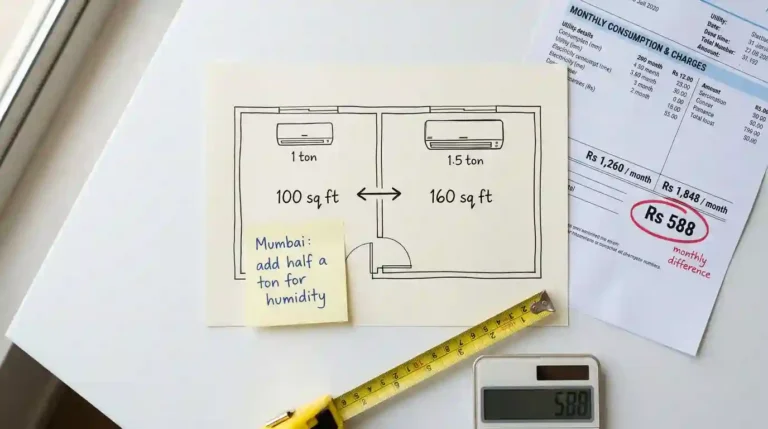
A common mistake is buying a 1.5 ton AC for a small room. Buyers are often sold on “1.5 ton cools faster,” which is technically true, but completely pointless when your room is tiny.
This is the most common 1 ton vs 1.5 ton AC mistake in India. Oversizing.
But undersizing is worse. Get a 1 ton AC for a west-facing 150 sq ft room in Mumbai during May, and you will be sweating at 2am with the AC running full blast and zero relief.
The right call between 1 ton vs 1.5 ton AC depends on three things: room size, your city’s climate, and how your flat is oriented. I’m giving you real numbers today. No vague “depends on usage” answers. And if you’re still deciding between AC and a cooler entirely, read our AC vs Air Cooler India 2026 comparison first.
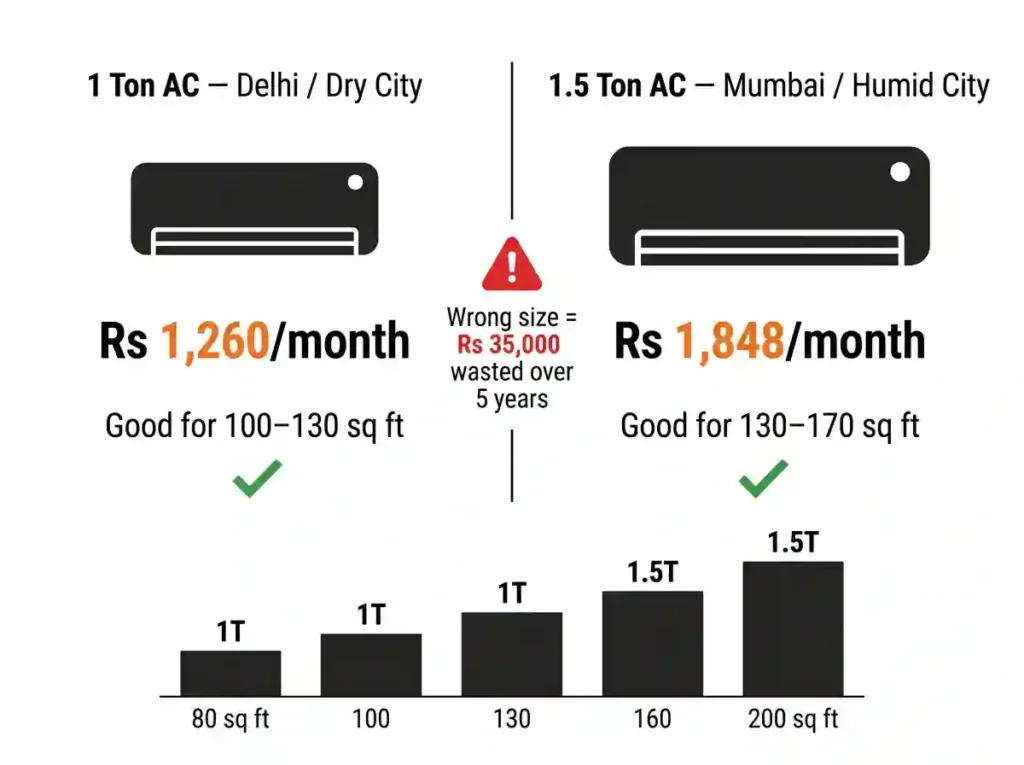
Rs 588 different every single month.
The only variable: room size and your city’s humidity.
Full room size chart at BestBudgetPicks.in
Table of Contents
- What Does “Ton” Actually Mean in an AC?
- Room Size: The Only Number That Should Drive Your Decision
- Electricity Bill: The Real Cost Difference With Real Numbers
- Mumbai vs Delhi: Same Question, Very Different Answer
- When to Buy 1 Ton AC
- When to Buy 1.5 Ton AC
- Our Verdict
- Frequently Asked Questions
What Does “Ton” Actually Mean in an AC?
Nothing to do with weight. “Ton” measures cooling capacity, which is how much heat your AC removes from the air per hour.
- 1 ton = 3,517 watts of cooling capacity
- 1.5 ton = 5,275 watts of cooling capacity
More tons means more cooling power and more electricity consumed. The gap between 1 ton vs 1.5 ton AC is 1,758 watts, roughly the same as running an electric iron continuously alongside your AC. The Bureau of Energy Efficiency (BEE) sets the efficiency standards that determine how much electricity each tonnage actually consumes under Indian conditions.
Room Size: The Only Number That Should Drive Your Decision
If you only take one thing from this guide, take this table:
| Room Size (sq ft) | Recommended Tonnage | Typical Use |
|---|---|---|
| Up to 100 sq ft | 1 ton | Small bedroom, study room |
| 100–130 sq ft | 1 ton | Standard bedroom |
| 130–170 sq ft | 1.5 ton | Master bedroom, large bedroom |
| 170–220 sq ft | 1.5 ton | Living room, dining area |
| 220–300 sq ft | 2 ton | Large hall, open plan |
Standard Indian apartments have bedrooms of 110–140 sq ft. That puts most homes right at the crossover point in the 1 ton vs 1.5 ton AC decision, which is exactly why people get confused.
But room size alone is not enough. Add half a ton if your room has any of these:
- Top floor (roof soaks up heat all day)
- West or south-facing wall (direct afternoon sun from 1pm onwards)
- More than 3 people regularly using the room
- Kitchen adjacent or semi-open layout
- Large glass windows or a floor-to-ceiling balcony door
Electricity Bill: The Real Cost Difference With Real Numbers
This is what the 1 ton vs 1.5 ton AC debate actually comes down to for most people: the monthly bill. Before reading further, it is worth understanding how BEE star ratings changed in 2026, since your “5-star” AC might now officially be rated lower, which changes these consumption numbers.
Assumptions: 8 hours/day, 5-star inverter AC, ₹7/unit average India tariff 2026
| AC Type | Units/Hour | Daily Usage (8 hrs) | Monthly Bill |
|---|---|---|---|
| 1 ton 5★ Inverter | ~0.75 units | 6 units | ~₹1,260 |
| 1.5 ton 5★ Inverter | ~1.1 units | 8.8 units | ~₹1,848 |
| Monthly difference | ₹588 | ||
| Annual difference | ₹7,056 |
Over 5 years, picking the right size in the 1 ton vs 1.5 ton AC decision saves you ₹35,000+ in electricity alone. That is more than the price gap between the two ACs.
The oversizing trap: A 1.5 ton AC in a 100 sq ft room does not stay cool longer. It reaches the set temperature quickly, shuts off, the room warms up, and kicks in again. This short-cycling wastes 20–30% more electricity and leaves the room feeling humid because short cycles do not run long enough to pull moisture from the air.
Mumbai vs Delhi: Same Question, Very Different Answer
This is the section most AC guides skip completely, and it genuinely changes the 1 ton vs 1.5 ton AC calculation depending on where you live.
Mumbai: The Humidity Problem
Mumbai’s AC problem is not just 38°C heat. It is 80–90% humidity from June through September. Your AC has to work twice as hard, first pulling moisture from the air and then cooling it down. This doubles the effective load on the compressor. Mumbai humidity is severe enough that it destroys furniture and causes fungal damage. If you have experienced this, our best dehumidifier guide for India covers that problem separately.
In Mumbai:
- 120 sq ft room: go 1.5 ton (would be fine with 1 ton in Delhi)
- West-facing or sea-facing room: definitely 1.5 ton
- Ground floor with shade from a neighbouring building: standard sizing is okay
- Monsoon months (June–September): your AC runs at 95%+ capacity constantly
Mumbai electricity tariff (MSEDCL/BEST): ₹7.5–8.5 per unit. Your monthly bill runs ₹200–400 higher than the Delhi equivalent for the same AC running the same hours.
Delhi: Intense Heat, But Dry Air
Delhi hits 45°C+ in May, but the air is dry at 15–25% humidity. Dry heat is significantly easier to cool since the compressor only fights temperature, not moisture load.
In Delhi:
- 130 sq ft room: 1 ton AC is usually enough
- Ground floor with some shade: 1 ton works perfectly
- Top floor DDA flat or south-facing: bump to 1.5 ton
- Offices in Connaught Place or South Ex area: higher heat load from glass facades, go 1.5 ton
Delhi electricity tariff (BSES/TPDDL): ₹5.5–7 per unit. Considerably cheaper to run than Mumbai.
The key insight is that the 1 ton vs 1.5 ton AC crossover point shifts by about 20 sq ft between Delhi and Mumbai. What comfortably handles a 130 sq ft room in Delhi needs 1.5 ton in Mumbai to match the same comfort level.
Other Cities Quick Reference
| City | Humidity Level | Sizing Tip |
|---|---|---|
| Mumbai, Chennai, Kolkata | Very High | Add 0.5 ton vs standard chart |
| Delhi, Jaipur, Ahmedabad | Low | Standard chart works fine |
| Bangalore | Moderate | Standard chart, rarely need to bump up |
| Hyderabad, Pune | Moderate | Standard chart, check floor level |
When to Buy 1 Ton AC
Choose 1 ton AC in the 1 ton vs 1.5 ton AC decision when:
- Room is under 130 sq ft
- Ground or middle floor, not top floor
- North or east-facing room with less afternoon and evening sun
- City has dry heat, such as Delhi, Jaipur, Ahmedabad, or Nagpur
- Budget matters, since 1 ton ACs are ₹5,000–8,000 cheaper for the same brand and star rating
- Maximum 2 people regularly use the room
When to Buy 1.5 Ton AC
Choose 1.5 ton AC in the 1 ton vs 1.5 ton AC decision when:
- Room is 130–220 sq ft
- Top floor flat, especially in Mumbai or Chennai
- West or south-facing walls taking direct afternoon sun
- High-humidity city such as Mumbai, Chennai, Kolkata, or Kochi
- 3 or more people regularly use the room
- Open kitchen connected to the living area
- Large glass windows or sliding balcony doors
Our Verdict
The 1 ton vs 1.5 ton AC choice is not about brand, not about star rating, and not about what the salesperson recommends. It is about matching cooling capacity to your room’s actual heat load.
Measure your room. Check which floor you are on. Look at which direction the sun hits your walls in the afternoon. If you are in Mumbai, add half a ton to whatever the standard chart says.
The electricity difference between 1 ton vs 1.5 ton AC is ₹588 per month, which adds up to ₹35,000 over 5 years. Getting this right once saves you money every single month for the life of the AC. Once you have picked your tonnage, check our BEE star rating guide to make sure you are buying the most energy-efficient model in that category, since the thresholds changed in 2026 and most buyers do not know.
If you are still on the fence: for most standard Indian bedrooms of 120–140 sq ft, 1.5 ton is the safer choice, especially if you are in a high-humidity city or on an upper floor. But do not let anyone sell you 1.5 ton for a 100 sq ft room.
Frequently Asked Questions
Can a 1 ton AC cool a 150 sq ft room?
It can, but it will struggle in peak summer, especially in humid cities. For a 150 sq ft room, 1.5 ton AC gives you comfortable cooling without the compressor running at maximum load constantly. In dry-heat cities like Delhi, a 1 ton might manage, but 1.5 ton is the right call.
Which uses more electricity, 1 ton or 1.5 ton AC?
A 1.5 ton AC uses approximately 40–50% more electricity per hour than a 1 ton AC. At 8 hours per day usage, the difference comes to around ₹588 per month or ₹7,000 per year. This is why the 1 ton vs 1.5 ton AC sizing decision directly impacts your electricity bill every month.
Does Mumbai’s humidity change which AC size I should buy?
Yes, significantly. Mumbai’s 80–90% monsoon humidity increases the effective cooling load by 10–15%. A room that works fine with 1 ton AC in Delhi might need 1.5 ton in Mumbai to maintain the same comfort. Always factor in humidity when making the 1 ton vs 1.5 ton AC decision for Mumbai homes.
Is 1.5 ton AC good for a bedroom in India?
For bedrooms between 130–170 sq ft, yes, 1.5 ton is ideal. For rooms under 120 sq ft, it is oversized. An oversized AC short-cycles with rapid on-off switching, consumes more electricity, and does not dehumidify properly, leaving the room feeling damp even when cool.
What is the price difference between 1 ton and 1.5 ton AC in India 2026?
Typically ₹5,000–8,000 for the same brand and star rating. A 5-star inverter 1 ton AC starts at around ₹28,000, while the equivalent 1.5 ton starts around ₹34,000–36,000. The electricity savings from choosing the right size recover this gap in 1–2 years.
Which AC should I buy for a 120 sq ft room?
In Delhi, Pune, or Bangalore, 1 ton is enough for 120 sq ft. In Mumbai, Chennai, or Kolkata, go for 1.5 ton because humidity adds to the cooling load even in smaller rooms. The answer genuinely depends on your city.
You Might Also Like
- AC vs Air Cooler India 2026: The Honest Comparison Nobody Actually Gives You
- BEE Star Rating 2026: Your 5-Star AC Might Now Be 4-Star
- Best Air Conditioner in India 2026: Top 5 Inverter ACs to Beat the Scorching Heat
- Best Dehumidifier in India 2026: Rs 6,000 of Shoes Destroyed by Monsoon Fungus
Sources
- Bureau of Energy Efficiency (BEE): AC Labelling Programme and ISEER Standards 2026
- MSEDCL (Maharashtra State Electricity Distribution Co.): Residential Tariff Rates 2026
- BSES Delhi: Domestic Electricity Tariff Schedule 2026
Reviewed by Nipul Patil: Consumer products researcher based in Mumbai. Every calculation in this guide uses verified BEE ISEER data and current state electricity tariff rates. No affiliate links in this article. Pure information. No paid promotions.