
If you have been eyeing a phone under Rs 25,000 in the last month and noticed the price crept up between the day you added it to your cart and the day you actually paid, you are not imagining it. This phone price hike in India 2026 is real, and it is hitting nearly every brand selling here, Samsung, Redmi, Realme, Vivo, Oppo, iQOO, Motorola, Nothing. This is a companion piece to our electronics price hike India 2026 explainer, which covers the “why” at a macro level. This one is the “which specific phones, and by how much” tracker, since that is the more useful question if you are actually about to buy one.
Why This Is Happening: The Memory Chip Shortage, Explained Simply
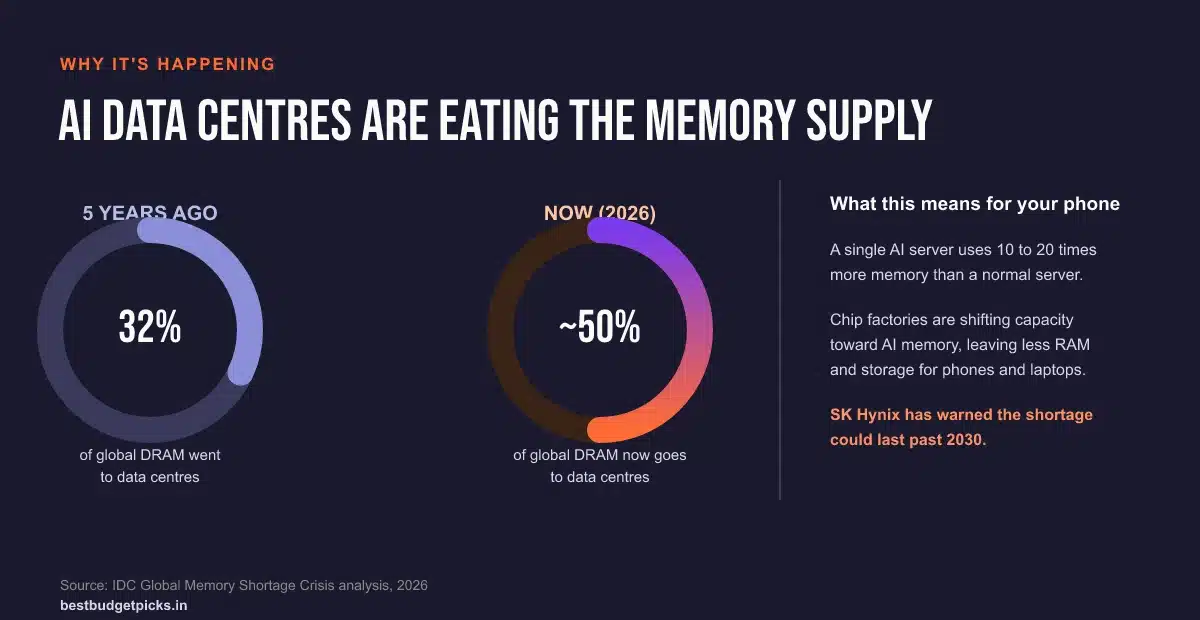
Every phone needs RAM and storage chips (DRAM and NAND flash). Those same chip factories also make the memory that powers AI data centres, the kind Google, Microsoft, Meta, and OpenAI are building at massive scale. A single AI server can use 10 to 20 times more memory than a normal server, and data centre demand has jumped from around 32% of global DRAM consumption five years ago to roughly 50% now, according to IDC’s 2026 memory shortage analysis.
Chip makers are reallocating factory capacity toward the high-bandwidth memory AI servers need, away from the ordinary RAM and storage that goes into your phone. Supply of everyday memory is not growing fast enough to cover both. DRAM contract prices reportedly jumped more than 50% quarter over quarter entering 2026, and some industry trackers have flagged the possibility of much steeper spikes through the rest of the year. Phone brands are passing that cost increase straight to the sticker price, and it shows up fastest on budget and mid-range phones because they run on the thinnest profit margins. A flagship can absorb a few hundred rupees of extra chip cost more easily than a phone that was already priced at Rs 12,000.
Is This an “AI Bubble”? Here’s the Honest Answer
You have probably seen the term “AI bubble” thrown around, the idea that tech companies are overspending on AI infrastructure and that spending could eventually slow down or reverse. That debate is real and unresolved, but it matters less for your phone-buying decision than you might think, for one specific reason.
Even if AI spending eventually cools off, the memory shortage does not reverse quickly. Chip factories take years to build and reconfigure, and manufacturers have already committed existing capacity to long-term supply contracts with AI companies. SK Hynix, one of the three major memory makers, has publicly warned the shortage could persist past 2030, according to industry reporting. So the practical answer is: whether or not AI turns out to be a bubble is a separate question from whether phone chip prices come down soon. Based on what memory manufacturers themselves are saying about their production commitments, a quick reversal is not the likely near-term outcome.
Phone Price Hike India 2026: Budget & Mid-Range Tracker
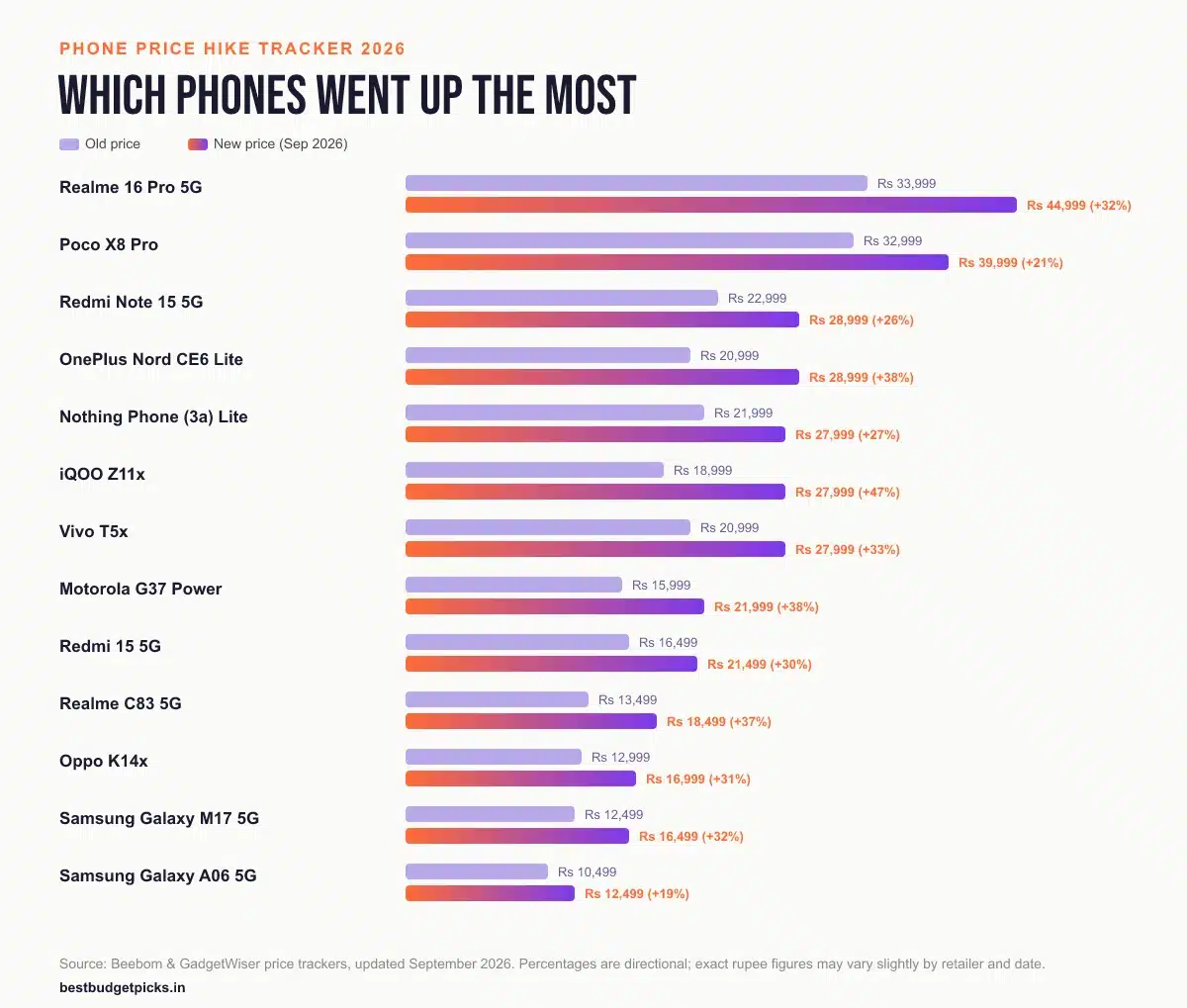
These are real, dated price movements pulled from active price-tracking coverage (sources listed below), focused on the budget and mid-range phones most relevant to Indian buyers. A note on accuracy: different trackers update at slightly different times and sometimes disagree by a few hundred rupees on the exact new price. Treat the rupee figures as directionally accurate and confirm the live price on Amazon or the brand’s own site before buying, since retailers adjust listings frequently right now.
| Phone | Old Price | New Price | Increase |
|---|---|---|---|
| Samsung Galaxy A06 5G | Rs 10,499 | Rs 12,499 | +Rs 2,000 (~19%) |
| Samsung Galaxy M17 5G | Rs 12,499 | Rs 16,499 | +Rs 4,000 (~32%) |
| Redmi 15 5G | Rs 16,499 | Rs 21,499 | +Rs 5,000 (~30%) |
| Redmi Note 15 5G | Rs 22,999 | Rs 28,999 | +Rs 6,000 (~26%) |
| Realme C83 5G | Rs 13,499 | Rs 18,499 | +Rs 5,000 (~37%) |
| Realme 16 Pro 5G | Rs 33,999 | Rs 44,999 | +Rs 11,000 (~32%) |
| Vivo T5x | Rs 20,999 | Rs 27,999 | +Rs 7,000 (~33%) |
| Oppo K14x | Rs 12,999 | Rs 16,999 | +Rs 4,000 (~31%) |
| Poco X8 Pro | Rs 32,999 | Rs 39,999 | +Rs 7,000 (~21%) |
| iQOO Z11x | Rs 18,999 | Rs 27,999 | +Rs 9,000 (~47%) |
| Motorola G37 Power | Rs 15,999 | Rs 21,999 | +Rs 6,000 (~38%) |
| Nothing Phone (3a) Lite | Rs 21,999 | Rs 27,999 | +Rs 6,000 (~27%) |
| OnePlus Nord CE6 Lite | Rs 20,999 | Rs 28,999 | +Rs 8,000 (~38%) |
The pattern above holds at the premium end too: the OnePlus 15R has reportedly gone up roughly Rs 7,000 to Rs 12,000 depending on the tracker and update date (its third hike since launch), and the OnePlus 15 and iQOO 15 have both moved up roughly Rs 13,000. Apple has not been spared either, iPhone 16 and iPhone 17 series prices have also risen by Rs 10,000 to over Rs 45,000 on higher storage variants, per the same trackers.
Should You Buy Now or Wait?
Based on everything above, waiting is unlikely to help. The underlying cause is a structural memory supply shift toward AI infrastructure, not a temporary retail promotion cycle, and manufacturers are indicating this could run for years, not months. If a phone on this list was already on your shopping list before the hikes, buying sooner rather than later is the more defensible call. If you are shopping fresh, budget an extra 20 to 35% over what you might remember phones costing even six months ago, and compare the current listed price against these tracked figures so you know whether a “discount” a retailer is offering is real or just a partial rollback of a price that was already raised.
FAQ: Phone Price Hike India 2026
Why are budget phones getting more expensive in India in 2026?
A global shortage of RAM and storage chips (DRAM and NAND) is the direct cause. Chip makers have shifted production capacity toward the memory used in AI data centres, leaving less supply for consumer electronics like phones. Budget phones show the increase most visibly because they run on the thinnest profit margins.
Is this an AI bubble that will burst and bring prices back down?
Whether AI spending itself is a bubble is a separate, unresolved debate. What is more certain is that memory chip factories have already committed years of production capacity to AI infrastructure contracts, and manufacturers like SK Hynix have said the shortage could last past 2030. So even in an AI slowdown scenario, a fast reversal in chip prices is not the likely near-term outcome.
How much more are phones costing right now compared to a few months ago?
Based on the tracked models above, budget and mid-range phones have risen roughly 19% to 47%, with most falling in the 25 to 35% range. Premium phones have also risen, typically by Rs 7,000 to Rs 15,000 per model.
Should I wait for a sale instead of buying now?
Given the cause is a structural chip shortage rather than normal retail pricing, waiting is unlikely to bring prices back down. If anything, further increases are more likely than a rollback based on what memory manufacturers are currently signalling about supply through 2026 and beyond.
Sources
- Beebom, India Smartphone Price Hike Tracker (updated September 14, 2026)
- GadgetWiser, Smartphone Price Hike List (updated September 10, 2026)
- IDC, Global Memory Shortage Crisis: Market Analysis 2026
- Tech Insider, 2026 Memory Chip Shortage: SK Hynix Warns It May Last Past 2030
Written by Nipul Patil: Motion designer and consumer electronics researcher based in Mumbai. This guide is informational only, no product recommendations or affiliate links, compiled from active price-tracking sources to help budget buyers make a timing decision. See our electronics price hike India 2026 piece for the deeper “why” behind AC, fridge, laptop, and phone pricing this year. Affiliate Disclosure


