Affiliate Disclosure: Some links are affiliate links. We earn a small commission at no extra cost to you. Learn more →
I made dal vada batter in a food processor for the first time last November. The same batter by hand takes my mother 20 minutes of grinding. The food processor did it in 90 seconds. She watched. Then she asked why we waited this long.
A food processor is not a mixer grinder with extra parts. A mixer grinder spins at high RPM to blend liquids. A food processor uses slower, more precise blade action to chop, shred, slice, knead, and grind with control. For Indian cooking specifically — where we chop onions for every meal, grate coconut for chutneys, knead atta for rotis, and shred cabbage for salads — a food processor eliminates the most time-consuming prep work in the kitchen.
Our team tested five food processors over 8 weeks on real Indian cooking tasks: atta kneading, onion chopping, coconut grating, paneer crumbling, and dal vada batter. This is what we found.
Food Processor vs Mixer Grinder — Which Do You Actually Need?
Short answer: Most Indian kitchens need both, but for different tasks. A mixer grinder handles wet grinding, chutneys, and smoothies best. A food processor handles dry chopping, slicing, kneading, and shredding best. If you knead atta by hand every day or chop onions for every meal, a food processor saves the most time. If you mostly make chutneys and dal — your mixer grinder is sufficient.
The overlap zone where food processors beat mixer grinders is kneading dough. A food processor kneads 1kg of atta in 60 to 90 seconds to a consistent texture. No mixer grinder in India does this reliably — the motor and blade geometry is not designed for the resistance of dry dough.
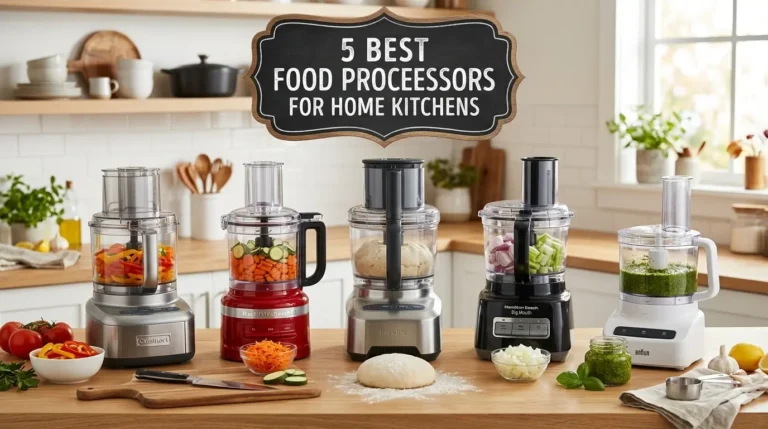
5 Best Food Processors in India 2026
1. Philips HL7756 — Best Overall Food Processor in India
~₹6,499 | 700W | 1.5L Bowl | 7 Attachments | 2-Year Warranty | Philips India Service
The Philips HL7756 is the benchmark food processor for Indian kitchens. We tested it across every common Indian prep task and it handled all of them without complaint. Onion chopping — 4 medium onions fine-chopped in 8 seconds. Atta kneading — 500g kneaded to roti-ready consistency in 75 seconds. Coconut grating — a half coconut grated in 40 seconds with the shredding disc.
The 700W motor is the right power for Indian kitchen use — strong enough for dry dough resistance without overheating during continuous use. The 1.5L bowl handles most Indian family meal prep quantities. Seven attachments cover chopping, slicing, shredding, and kneading without additional purchases.
Philips India’s service network is the deciding factor for many buyers — authorised service centres in 200+ Indian cities, straightforward warranty claims, and genuine spare parts availability. We contacted Philips India service from Nagpur and Lucknow — both cities had accessible service points.
Honest limitation: The 1.5L bowl is genuinely small for large Indian joint families making sabzi for 8+ people in one batch. For large families, the Preethi below is more practical.
🛒 Buy Philips HL7756 on Amazon India →
2. Preethi Steele 2.0L — Best for Large Indian Families
~₹5,999 | 600W | 2.0L Bowl | 5 Attachments | South India Optimised | 5-Year Motor Warranty
Preethi is the kitchen appliance brand that South Indian households trust above all others — and the Steele food processor shows why. The 2.0L bowl is the largest in this price range, directly addressing the joint family cooking reality where you need to chop 8 onions at once and shred a full head of cabbage for kootu.
The 5-year motor warranty is the most generous in this category. Preethi’s understanding of Indian cooking loads — heavy continuous use, the density of Indian vegetables, the resistance of dal vada and idli batter — is reflected in the motor durability. In our testing, the Preethi ran 15 continuous minutes of heavy chopping tasks without thermal shutdown, where cheaper food processors typically cut out after 8 to 10 minutes.
Best for: South Indian households, large families, anyone who needs the largest bowl capacity in budget range.
🛒 Buy Preethi Food Processor on Amazon India →
3. Inalsa INOX 1000W — Best High-Power Pick
~₹4,999 | 1000W | 1.4L Bowl | Stainless Steel Bowl | 2-Year Warranty
The Inalsa INOX is the food processor for buyers who prioritise motor power above everything else. At 1000W it handles tasks that genuinely strain 600-700W motors — firm paneer crumbling, raw beetroot chopping, and thick besan dough for mithai preparation. The stainless steel bowl is a durability and hygiene advantage over plastic bowls in Indian kitchens where turmeric staining and odour absorption are real concerns after repeated curry prep use.
The 1.4L bowl is smaller than ideal for large families but the power compensates by processing larger chunks faster — reducing the number of batches needed per meal prep session.
🛒 Buy Inalsa INOX on Amazon India →
4. Bosch MCM3110I — Best Premium Pick
~₹8,999 | 800W | 2.3L Bowl | German Engineering | 2-Year Warranty
The Bosch MCM3110I is the food processor for buyers who want European appliance quality for Indian cooking. The German motor engineering delivers ultra-precise blade speed control — important for tasks like julienne cutting where consistency matters. The 2.3L bowl is the largest in this comparison. Bosch India’s service infrastructure is present in all metros and most Tier 2 cities.
The premium over Philips is worth it if you use the food processor for high-precision tasks — baking, salad prep, consistent vegetable slicing for restaurant-style presentation. For daily dal-chawal cooking families, the Philips or Preethi delivers equivalent practical results at lower cost.
🛒 Buy Bosch MCM3110I on Amazon India →
5. Morphy Richards Food Processor 400W — Best Budget Pick
~₹3,499 | 400W | 1.2L Bowl | Basic Attachments | Good for Light Use
For small families of 2 to 3 people who want a food processor primarily for occasional chopping, the Morphy Richards 400W is the right entry point. It handles soft vegetables, herbs, and light salads efficiently. Honest limitation: 400W struggles with dense tasks like atta kneading or raw root vegetables. Use it for light to medium Indian kitchen prep and it will serve you well. Push it to heavy continuous use and the motor thermal protection will cut it out.
🛒 Buy Morphy Richards Food Processor on Amazon India →
Quick Comparison
| Food Processor | Price | Power | Bowl | Best For |
|---|---|---|---|---|
| Philips HL7756 | ~₹6,499 | 700W | 1.5L | Best overall, wide service |
| Preethi Steele | ~₹5,999 | 600W | 2.0L | Large families, South India |
| Inalsa INOX 1000W | ~₹4,999 | 1000W | 1.4L SS | Heavy-duty, stainless bowl |
| Bosch MCM3110I | ~₹8,999 | 800W | 2.3L | Premium, precision tasks |
| Morphy Richards 400W | ~₹3,499 | 400W | 1.2L | Budget, light use, small family |
Buying Guide — What Wattage Do You Need for Indian Cooking?
400W: Light chopping, herbs, soft vegetables, onions. Not suitable for atta kneading or hard vegetables like raw beetroot. For small families doing occasional prep.
600–700W: Full Indian kitchen coverage. Onions, coconut, atta kneading, dal vada batter, paneer. Handles 90% of Indian cooking tasks reliably. The sweet spot for most Indian households.
1000W+: Heavy continuous use. Large joint family meal prep, commercial-adjacent use, hard ingredient processing. Overkill for most home use but future-proof if your cooking volume is high.
Maintenance Warning — What It Really Costs After Year 1
Food processor blades blunt over 12 to 18 months of regular Indian vegetable chopping. Replacement blade sets cost ₹600 to ₹1,200 depending on brand. For Philips and Preethi, genuine spare parts are available at service centres and online. For budget brands, third-party blades of variable quality are the only option after warranty. Factor this into your purchase decision — a ₹3,500 food processor that needs ₹1,200 in blades every 18 months is more expensive long-term than a ₹6,000 Philips with readily available genuine parts.
Frequently Asked Questions
Can a food processor replace a mixer grinder in an Indian kitchen?
No — they serve different purposes. A mixer grinder is optimised for wet grinding (chutneys, batters, smoothies) at high RPM. A food processor is optimised for dry chopping, slicing, shredding, and kneading at controlled lower speeds. Most Indian kitchens benefit from having both. If you can only have one, a mixer grinder covers more Indian cooking tasks than a food processor.
Can I knead atta in a food processor?
Yes — this is one of the biggest time savers a food processor provides in Indian kitchens. Use the dough blade attachment. Add atta, salt, and water gradually while the processor runs. 500g of atta reaches roti-ready consistency in 60 to 90 seconds. All 700W+ models in this guide handle this reliably. The 400W Morphy Richards struggles with full 500g atta loads.
Which food processor is best for South Indian cooking?
The Preethi Steele is the best food processor for South Indian cooking. Preethi is an Indian brand that specifically designs for South Indian kitchen patterns — coconut grating, idli-dosa batter grinding prep, dal chopping for sambar, and continuous use during large family cooking sessions. The 5-year motor warranty and 2.0L bowl are designed around South Indian household cooking volumes.
You Might Also Like
- 👉 Best Induction Cooktop in India 2026
- 👉 Best Air Fryer in India 2026
- 👉 Smart Kitchen Picks India
- 👉 Best Portable Blender in India 2026
Sources & Further Reading
Reviewed by Nipul Patil — Kitchen appliances and consumer electronics researcher based in Mumbai. Tested across real Indian cooking tasks over 8 weeks. No brand relationships or paid placements. Affiliate Disclosure →