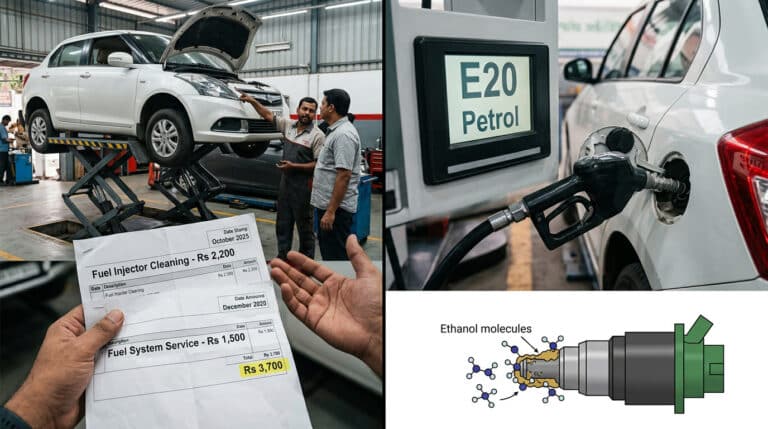
Short answer: E20 petrol is petrol blended with 20% ethanol. The Petroleum Ministry says it does not harm engines and that the mileage drop is small. Experts quoted in the press expect a small drop and say some older parts such as rubber gaskets and hoses could wear faster in cars that are not E20 compliant. Whether your car is ready depends on its model and year, so check the manual or ask the maker. This is an explainer, not a repair guide, and we have not tested any car on E20.
What is E20 petrol?
E20 is a blend of 20% ethanol and 80% petrol. India has raised the ethanol share in stages. Press reports of a government statement say the country reached an average of 20% blending in the 2025-26 ethanol supply year, and the government says it has no decision to go beyond 20%.
What does the government say?
The Ministry of Petroleum and Natural Gas, as reported by news outlets, estimates a small mileage decrease: about 1 to 2% for four-wheelers designed for E10 and calibrated for E20, and about 3 to 6% in others. It says studies and testing show no harmful effect on engine function, fuel consumption or vehicle life. It also says E20 does not affect insurance validity, and that carmakers continue to honour warranty claims. It has said some manufacturers’ vehicles have been E20 compatible since as early as 2009. Reports also say road transport minister Nitin Gadkari acknowledged that a few older vehicles may need new gaskets.
What do critics and experts say?
Some car experts quoted in the press expect a 2 to 5% drop in fuel efficiency. Engineers note that in vehicles that are not E20 compliant, rubber parts such as gaskets, fuel hoses and pipes could wear in the long term, though not immediately. Many owners have complained online about lower mileage. The government told Parliament it has not assessed what share of petrol vehicles are fully E20 compatible. One carmaker’s service data, cited in government material, reported no E20 linked corrosion or abnormal wear across vehicles it serviced, including many not originally certified for E20. We have not verified these figures ourselves.
How to check your car
- Look for the E20 label: many newer cars show E20 compatibility on the fuel cap or in the manual.
- Ask the maker or service centre: give your model and year and ask if it is E20 ready and whether any parts need replacing.
- Older cars: ask a mechanic to inspect rubber fuel lines and seals at your next service.
- Track mileage properly: fill to the same level, note the odometer and compare kilometres per litre over several fill ups. One tank is not enough.
- If something changes: a rough idle, hard starting or a warning light can have many causes. Have an authorised service centre diagnose it instead of assuming it is the fuel.
Frequently asked questions
Does E20 petrol damage car engines? The Ministry says studies show no harmful effect on engines. Engineers quoted in the press say older non compliant cars may see wear on rubber parts over the long term. Check with your maker.
How much mileage will I lose on E20? The Ministry estimates 1 to 2% for cars calibrated for E20 and 3 to 6% for others. Some experts expect 2 to 5%. Your own number depends on the car and how you drive.
Does E20 petrol void my warranty or insurance? The Ministry says it does not affect insurance validity and manufacturers have said they honour warranty claims. Check your own policy and warranty terms.
Is my car E20 compatible? Check the manual, the fuel cap label or ask the maker with your model and year.
Sources
- Autocar Professional: What the government says about E20 mileage and engine concerns
- Moneylife: Govt rejects E20 concerns, some older vehicles need new gaskets
- Outlook Business: Fuel efficiency may drop 2 to 5% due to E20, car experts
- The Tribune: E20 petrol offers improved acceleration, clarifies oil ministry
- Outlook Money: Government has not assessed the number of E20 compatible vehicles
Written by Nipul Patil. This article summarises public statements and press reports as of October 2026. We have not tested vehicles on E20 and do not give repair advice. For your own vehicle, consult the maker or an authorised service centre.